
O,1,2nine
2012 | Comedy / Performance
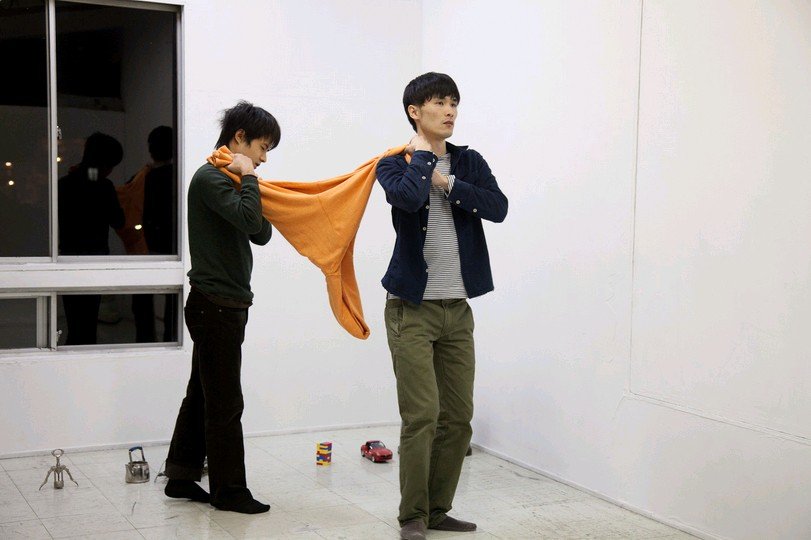
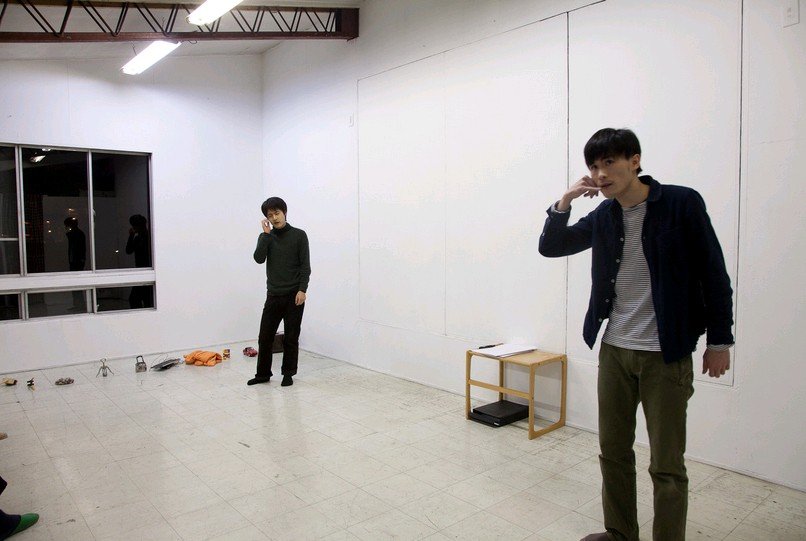
This was the debut performance of O,1,2nine, a unit formed by TARKY Toshima and Masayuki Yoshida. The fact that the unit's name and the performance title were the same was simply due to a lack of time to come up with a separate title for the show.
The introduction to O,1,2nine at the time read as follows. Basically, what they do has not changed since then.
“Formed on November 29, 2011. A unit consisting of Masayuki Yoshida, from the sketch comedy group Tennis Court, and artist TARKY Toshima. We do things that one person could do, but with two people, and things that two people could do, also with two people.”
Performance program of O,1,2nine
- Corkscrew
- Are-Kore-Sore
- Hoodie
- Double Oogiri: Yoshida answers an oogiri prompt. Without seeing the original prompt, Toshima takes Yoshida's answer as a new prompt and responds to that instead.
- Mono no Aware: Toshima takes a prompt written by Yoshida and performs it. Afterward, objects placed on the floor are moved according to a set of rules. The piece was performed with taoyame and masurao as an underlying reference.
Cultural and Linguistic Notes for English Readers
1. The Name O,1,2nine
The unit's original Japanese name, O,1、2人, is read “Ō, ichi, ni-nin.” It combines a letter, numerals, and the Japanese counter for people in a deliberately unconventional name. The unit's English name is O,1,2nine.
The unit was formed on November 29, 2011, by Masayuki Yoshida, a member of the Japanese sketch comedy group Tennis Court, and TARKY Toshima, an artist. The 2012 performance marked its debut.
2. Oogiri: Comedy Through Improvised Responses
Oogiri (大喜利) is a Japanese comedy format in which performers respond to a prompt, question, image, or situation with an unexpected or humorous answer. The pleasure lies in the ingenuity of the response and in the surprising connections the performer makes.
In Double Oogiri, the usual process is extended by one step. Yoshida answers a prompt, but Toshima does not see that original prompt. Instead, Toshima treats Yoshida's answer itself as a new prompt. The answer thus becomes the question for the next performer, creating a chain in which each response changes the terms of the next one.
For background on the term's history, see Kotobank's entry on 大喜利.
3. Are-Kore-Sore and the Wordplay in the Short Sketches
The Japanese expressions kore, sore, and are form a demonstrative series:
- Kore (これ): this, near the speaker
- Sore (それ): that, associated with the listener or something already under discussion
- Are (あれ): that over there, away from both speaker and listener
The title Are-Kore-Sore plays with these ordinary expressions for referring to things.
“Are-Are Scam” plays on ore-ore sagi (オレオレ詐欺), the Japanese name for a telephone impersonation scam in which a caller pretends to be a relative or another trusted person, often claiming to need money urgently. The expression ore-ore means roughly “It's me, it's me.” Replacing ore (“I” or “me,” in a casual masculine register) with are (“that over there”) creates an absurd shift from a claim of personal identity to a demonstrative pronoun.
“Sore-Sore” uses the sound and repetition of sore, another word in this demonstrative series.
“Koree Rice” plays on the sound of karē raisu (カレーライス, curry rice) and the colloquial expression karē, kore! (辛ぇ、これ!), roughly “This is spicy!” The joke folds the expression of surprise about the food back into the name of the dish. Because the pun depends on Japanese pronunciation, it cannot be reproduced directly in English.
4. Mono no Aware, Taoyame, and Masurao
Mono no aware (もののあはれ), often translated as “the pathos of things,” refers to a sensitivity to the poignancy of things and to the feelings stirred by their transience. It is a major concept in discussions of classical Japanese literature, though the title alone does not determine the content of this particular sketch.
Taoyame (手弱女) and Masurao (益荒男) are contrasting classical terms. Taoyame suggests a graceful, delicate woman, while Masurao suggests a strong, vigorous man.
The terms also have a history in Japanese poetic criticism. In later discussions of poetic style, taoyame-buri became associated with the refined, delicate manner attributed to the Kokin Wakashū, while masurao-buri was associated with the forceful, expansive manner attributed to the Man'yōshū. This contrast was influential in later literary criticism, although it should not be mistaken for a simple description of every poem in either anthology.
For reference, see Kotobank's entries on Taoyame-buri and Masurao-buri.