
Kakushigoto Kamen (The Secret Mask)
2010 | Comedy / Performance
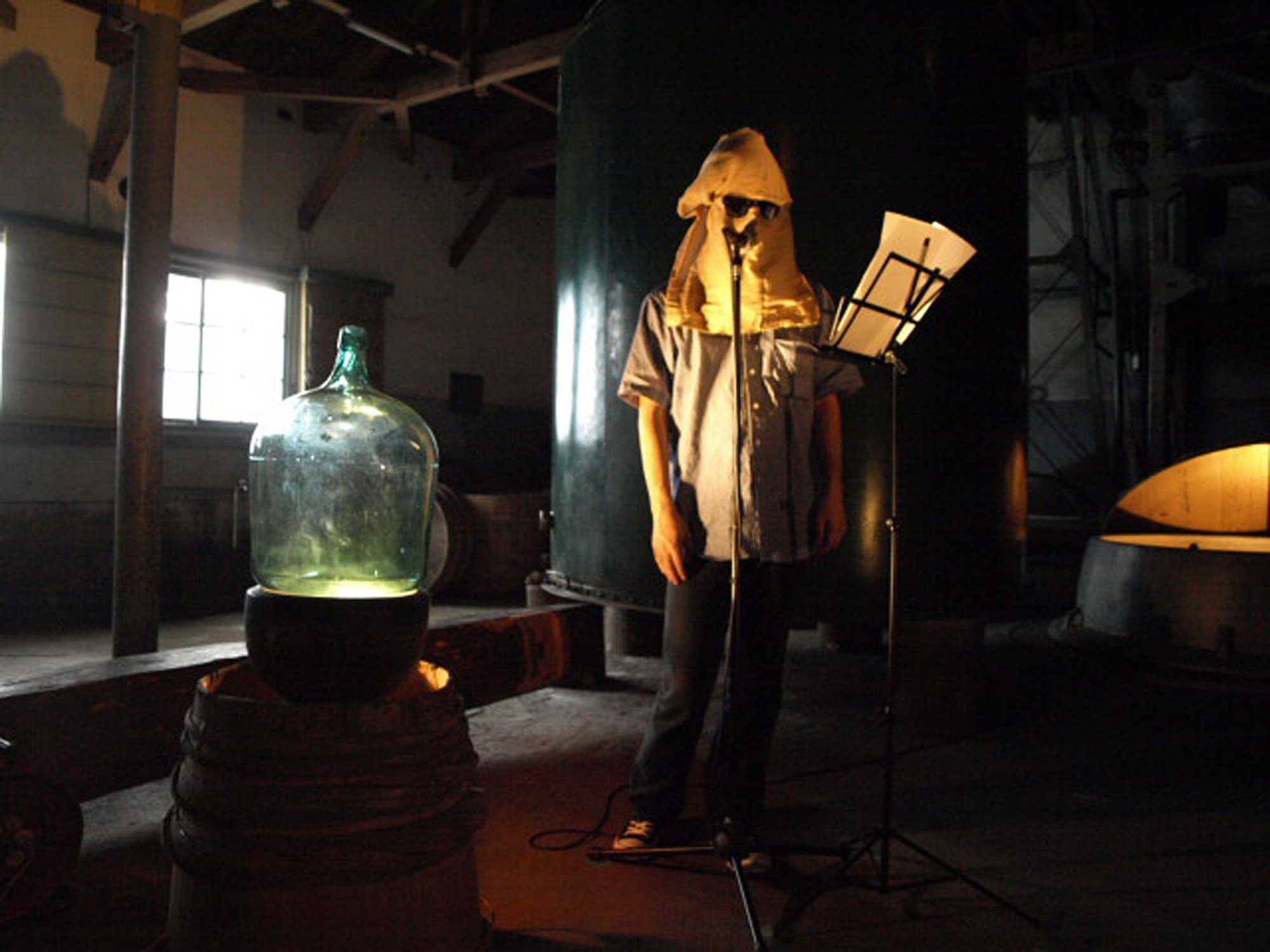
This was a performance and recitation piece presented at the Oku-no-in Nakanojo Onsen-kyo Art Festival 2010 in Nakanojo, Gunma Prefecture.
Since “Masks” was a theme for the festival that year, I simply took the theme as it was, put it straight into the title, and dressed accordingly. The piece features a long, drawn-out story about a man hiding his secret savings (hesokuri). Just when his secret stash of money is about to be discovered by his wife, Kakushigoto Kamen (the Secret Mask) makes an appearance.
If I remember correctly, I also made a pocket in the mask itself (see photo), from which I took various props to use during the performance. But I don't remember the details very clearly. Or perhaps it's better to leave the finer details hidden here as my own little secret.
Cultural and Historical Notes for English Readers
1. Kakushigoto (かくしごと): Something Kept Secret
Kakushigoto means something kept hidden from others, a secret or a matter one does not want to disclose. In this work, the word refers specifically to the money the protagonist is trying to keep from his wife.
The title Kakushigoto Kamen turns this everyday idea of concealment into the name of a masked character.
2. Hesokuri (へそくり): Secret Savings
Hesokuri refers to money that someone saves privately, often without a spouse or other family members knowing about it. It can be translated as “secret savings,” “a private stash,” or “money kept on the side,” depending on the context.
The word has an interesting history. One influential explanation traces it to hesokuri-gane (綜麻繰り金), money accumulated by winding heso (綜麻), bundles or coils of spun hemp thread. People, particularly women doing domestic work, could earn small amounts by winding thread and save the money they earned.
Another explanation connects heso with 臍, the Japanese word for “navel,” referring to money hidden on the body, such as inside a waist wrap worn around the belly. This association is reflected in the familiar spelling 臍繰り.
The precise etymology is not entirely settled, however. The connection with winding spun hemp thread is generally regarded as the more convincing explanation.
In contemporary usage, hesokuri commonly refers to a private reserve of money kept outside the openly shared household finances. Here, the protagonist is a man hiding such savings from his wife.
Reference: Kotobank, “へそくり” and “臍繰金”
3. The Festival Context: Oku-no-in Nakanojo Onsen-kyo Art Festival 2010
The Oku-no-in Nakanojo Onsen-kyo Art Festival 2010 was an art exhibition held at multiple locations in Nakanojo, Gunma Prefecture, from July 17 to August 29, 2010. It was organized by the Nakanojo Biennale Executive Committee. The festival's catalogue describes an exhibition involving paintings, sculpture, photography, and installation.
Reference: CiNii Books, Onsenkyo Art Festival: Oku-no-in Nakanojo (2010 exhibition catalogue)